
If you’ve been running your marketing through five different tools that never seem to agree with each other, you already know the frustration. Data lives in silos, campaigns launch late, and the insights you need are buried somewhere between three dashboards.
Awius is a digital marketing platform designed to fix exactly that problem. It connects your campaigns, your customer data, and your analytics into one working system — so your team spends less time managing software and more time making decisions that actually move your business forward.
What Is Awius and Why Are Businesses Paying Attention
Awius is a unified digital marketing platform built around a single, practical idea: your marketing tools should work together, not against each other. Most businesses today run their paid ads on one platform, track their email performance on another, monitor social media engagement somewhere else, and then spend hours every week trying to stitch the data into something meaningful.
Awius eliminates that cycle entirely. The platform combines campaign management, AI-powered analytics, customer profiling, and automation into one environment. You don’t need a developer to set it up or a dedicated operations team to keep it running.
Whether you’re a growing e-commerce store or a mid-market B2B company, Awius is designed to give you a complete marketing view without the overhead of managing a dozen separate subscriptions.
The Real Cost of Running Disconnected Marketing Tools
Here’s something most marketing leaders don’t sit down to calculate: the actual cost of running disconnected tools isn’t just the monthly subscriptions. It’s the time. One mid-sized company estimated their team spent fifteen hours every single week doing nothing but consolidating data from different platforms — roughly $50,000 per year in labor cost for work that created zero strategic value.
That’s not an unusual story. Most marketing teams burn between 20% and 30% of their working hours on tool management instead of campaign strategy. When your paid ads team can’t see the full customer journey, they optimize for the wrong metrics.
When your content team doesn’t know what converts, they produce material that looks great but generates no pipeline. Awius removes that integration tax.
How Awius Works as a Single Connected Marketing System
The core of what makes Awius different is that it treats your entire marketing operation as one connected system rather than a stack of features bolted together. Every customer interaction — an email open, a website visit, a social media click, a form submission — flows into a single unified customer profile.
Your team can see the complete picture of any customer’s journey without toggling between platforms. Beyond visibility, Awius handles cross-channel campaign orchestration, meaning you can launch, monitor, and adjust campaigns across paid search, social, and email from one interface.
Budget decisions become faster because the performance data you need is already consolidated. The platform also generates AI-driven recommendations based on patterns it identifies across your entire marketing dataset, not just one channel in isolation.
Real Business Results That Show Awius Is Working
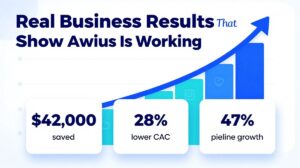
The best measure of any marketing platform is what actually happens after a business starts using it. An e-commerce company switched to Awius and reduced their marketing tech stack from seven separate platforms down to one.
That consolidation alone cut their software costs by $42,000 annually. More importantly, their customer acquisition cost dropped by 28% because they could finally see which channels were working together to close conversions.
A B2B SaaS provider discovered through Awius that webinar attendees who had previously downloaded a specific whitepaper converted at five times the rate of other attendees. That single insight, which their old tools could never surface, allowed them to restructure their entire funnel and grow their qualified pipeline by 47% within two quarters of making the switch.
What Awius Does Differently Compared to Traditional Platforms
Traditional marketing suites are additive by design. You start with a core product, realize it doesn’t handle attribution well, add a module, then add an integration, then add a third-party connector — and before long you’re paying for eight products and managing a part-time job just keeping them synced. Awius takes the opposite approach.
Unified customer data is built in across all channels from the start, not available as an expensive add-on. Cross-channel attribution works automatically with AI-driven insights rather than requiring manual setup.
Most businesses are fully operational on the platform within two to three weeks, compared to the three to six months that enterprise suite migrations typically require. The learning curve is designed for marketers, not engineers, which means your team actually uses it.
The Hidden Patterns Awius Surfaces That Other Tools Miss
One of the most valuable things Awius does is find the patterns hiding in the gaps between your data sources. A retail client using the platform discovered that website visitors who had engaged with their Instagram content but didn’t convert immediately had a three times higher lifetime value when they eventually did purchase.
Their previous tools showed Instagram engagement data and purchase data in completely separate dashboards, so that connection was invisible. Once Awius linked those data points automatically, the company shifted budget toward Instagram remarketing and saw a 34% increase in return on investment.
This kind of cross-channel pattern recognition isn’t something you can build manually by exporting spreadsheets. It requires a platform where all your data already lives together and talks to itself in real time.
Who Gets the Most Value From Using Awius
Awius delivers the strongest results for businesses that are already spending meaningfully on marketing across more than two channels. If your monthly marketing budget is $10,000 or more and you’re currently using three or more disconnected tools to manage it, the platform’s consolidation benefits alone often justify the switch before you even account for the performance gains.
E-commerce companies benefit from the unified customer journey tracking and cross-channel attribution. B2B companies benefit from the ability to follow leads across long, multi-touch sales cycles without losing data between handoffs.
Service businesses with multiple locations — like a healthcare network managing campaigns across twelve regional offices — gain central oversight while still allowing local teams to control their own campaigns. The platform shortens campaign launch time dramatically across all these use cases.
What’s Coming Next for Awius as a Platform
Awius is actively expanding its integration capabilities. The platform’s development roadmap includes direct connections to major e-commerce infrastructure, deeper CRM integrations specifically built for B2B sales workflows, and predictive modeling tools that can forecast campaign performance before you commit budget.
There’s also meaningful movement toward industry-specific solutions. Retail marketers face fundamentally different challenges than SaaS companies or professional services firms, and Awius is building templated workflows and performance benchmarks tailored to those distinct verticals.
The broader goal is to make sophisticated marketing infrastructure accessible to companies that don’t have enterprise budgets or dedicated marketing operations teams. The businesses that consistently win in digital marketing aren’t the ones with the most tools — they’re the ones that act on insights faster than their competitors can respond.
How to Know If You’re Ready to Make the Switch to Awius
There are three clear signals that your current marketing setup is holding you back. First, if your data tells a different story depending on which platform you’re looking at, you don’t have a visibility problem — you have an integration problem, and it’s costing you real money in poor decisions.
Second, if your team regularly delays campaign launches because someone is waiting on a report from another tool, your technology is slowing down your strategy rather than accelerating it.
Third, if you know opportunities exist in your customer data but you can’t quite see where they are, it means your tools are storing data but not connecting it. Awius addresses all three of these pain points through a single transition rather than another round of adding software on top of software.
Conclusion: Why Awius Represents Where Digital Marketing Is Heading
The marketing landscape has too many tools and not enough integration. Awius represents a clear shift in how businesses should think about their marketing infrastructure — not as a collection of separate products to be managed, but as a single connected system to be leveraged.
Businesses that have made the switch are saving tens of thousands of dollars annually, making faster decisions with better data, and uncovering revenue opportunities their old setups could never surface.
If your team is spending more time managing technology than designing campaigns, Awius offers a practical, proven way out of that cycle. The platform is already here, it’s already delivering results, and for most businesses dealing with fragmented marketing tools, the only real question is how long they can afford to wait.