
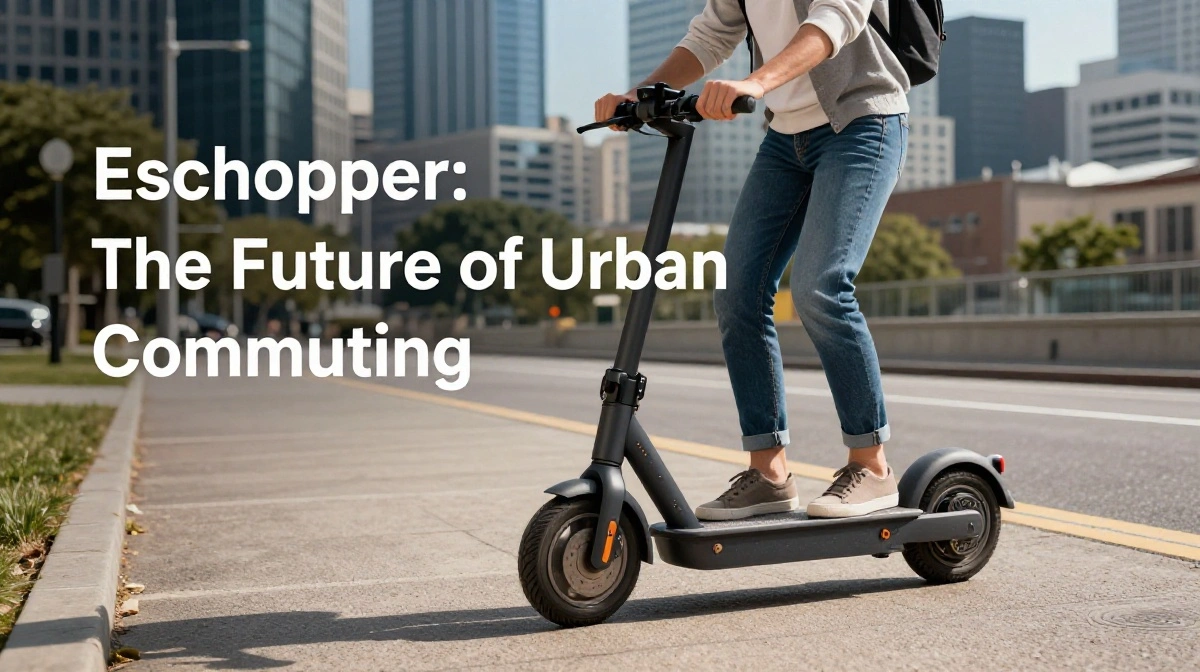
The situation becomes frustrating because Americans prefer Eschopper scooters as their primary transportation method. An Eschopper functions as an electric personal scooter designed to operate in contemporary urban spaces through its combination of intelligent technology and environmentally friendly design and practical real-world application.
The vehicle operates smoothly for all distances ranging from three-mile work commutes to complete cross-town trips. The Eschopper maintains its speed of development through the growing urban areas of U.S. cities and their operational progress from each mile traveled to every battery charged.
What Exactly Is an Eschopper and How Does It Work
Eschopper scooters function as electric vehicles designed specifically for urban and suburban travel yet their name has extended to include all high-quality personal electric vehicles that come with multiple features.
Unlike budget scooters you’d find at a big-box store, an Eschopper typically runs on a lithium-ion battery pack capable of delivering 25 to 40 miles per charge, depending on the model and rider weight.
Most motorbikes have their motors installed in the rear wheel hub which enables them to achieve smooth acceleration without needing drivers to use a clutch or shift gears. The majority of models achieve speeds that range from 15 mph to 20 mph which provides sufficient speed for operating on city streets.
Riders charge the battery using a standard home outlet, and a full charge takes roughly four to six hours. The mechanics are refreshingly simple — no gasoline, no oil changes, and no complicated maintenance schedule to worry about.
The Real History Behind Electric Scooter Culture in the U.S.
Electric scooters existed before their current appearance because they needed time to develop into their present form. The concept started gaining traction in the early 2000s when battery technology became affordable enough for consumer-grade products.
Early models were clunky and limited, often maxing out at 10 mph with a range of fewer than 10 miles. Everything changed around 2017 and 2018 when companies like Bird and Lime flooded American cities with dockless rental scooters, and millions of people got their first taste of electric scooting.
The cultural change increased requirements for individually owned devices which permitted people to customize their machines and use them throughout the day and claim them as personal property. The Eschopper emerged from this wave as a symbol of the more serious, committed electric scooter rider.
By 2023, the personal electric scooter market in the U.S. had surpassed $1.2 billion in annual sales, and rider demographics had expanded far beyond teenagers to include working professionals, delivery workers, and retirees exploring greener lifestyles.
Why American Commuters Are Choosing Eschopper Over Cars
Here’s something most people don’t realize until they actually crunch the numbers. The average American spends over $10,000 per year on car ownership when you factor in insurance, gas, parking, and maintenance.
An Eschopper, by contrast, costs between $400 and $1,500 upfront depending on the model, and the annual operating cost rarely exceeds $50 in electricity. That’s a financial difference that changes lives, especially in high-cost cities like San Francisco, New York, or Chicago. Beyond money, there’s the time factor.
Riders maintain their commuting time through traffic avoidance and parking exclusion which enables them to save 15 to 25 minutes of their travel time. The solution allows you to secure your item directly at your end point without needing to drive around the area or pay for parking or incur meter charges.
For trips under five miles, the Eschopper genuinely outperforms a car in almost every practical category, and more riders are realizing this every single day.
How Eschopper Models Compare Across Different Rider Needs
The strength of this segment comes from the fact that every Eschopper system does not share identical construction. Entry-level models weigh less than 25 pounds which allows users to transport them onto subways and store them underneath desks.
They’re perfect for flat urban environments where the rider just needs reliable point-A-to-point-B transportation. Mid-range models step up with larger batteries, dual suspension systems, and wider decks that make longer rides more comfortable.
The sweet spot for American commuters who travel five to fifteen miles through their daily round trips occurs between these two distances. The premium options include products that use aircraft-grade aluminum frames and regenerative braking systems together with integrated displays which show speed and battery life and trip distance in actual time.
Some high-end models even connect to smartphone apps that allow riders to track their route history, lock the scooter remotely, and receive diagnostics updates. The variety genuinely means there’s an Eschopper-style electric scooter designed for nearly every lifestyle and budget.
Safety Features That Make Modern Eschoppers Worth Trusting
New riders show their most common safety concerns because they doubt their ability to operate a vehicle. The early electric scooters used to have dangerous night riding problems because their brakes and lights did not function properly. Today’s scooters in the Eschopper category show significant progress when compared to their previous performance.
Dual braking systems — usually a combination of electronic regenerative braking and a rear disc or drum brake — give riders precise stopping power in under 10 feet at typical city speeds.
Front and rear LED lights are now standard on quality models, with some featuring side-mounted visibility lights that make the rider visible from nearly 300 feet away in low-light conditions. Wider, pneumatic tires absorb road vibration and reduce the chance of a wipeout on uneven pavement, a real issue in older American cities with cracked streets.
The National Safety Council’s 2024 micromobility research shows that riders who wear high-quality helmets and wrist guards achieve more than 85% injury protection. Safe riding requires both effective equipment and responsible rider practices.
U.S. Regulations and Where You Can Legally Ride an Eschopper
Every rider must learn the legal requirements for electric scooter operation in America before they start riding. The regulations differ from one state to another and from one city to another.
In California, for example, riders must wear a helmet if they’re under 18, and scooters are restricted to bike lanes or roads with speed limits under 25 mph. New York City has specific rules about which streets allow electric scooters, and violating those rules can result in fines starting at $500.
Most states classify electric scooters under 750 watts as low-speed vehicles, meaning no license or registration is required — but that classification isn’t universal. Several states, including Georgia and Texas, have more permissive laws that allow scooter riding on most public roads without special permits.
You need to dedicate twenty minutes for research about your local ordinances before making your purchase decision. The Department of Transportation website for your city operates as the most reliable source to provide this information which will help you avoid costly legal issues with police officers.
The Environmental Impact of Switching to an Eschopper
The environmental argument for the Eschopper is compelling, though it’s worth being honest about both the benefits and the nuances. A standard gasoline-powered car produces roughly 4.6 metric tons of CO2 per year. Replacing even a quarter of your car trips with an Eschopper ride meaningfully reduces your personal carbon footprint.
Electric scooters produce 22 grams of CO2 emissions for each mile they travel because their total emissions depend on the electricity used for their operation which generates emissions. The daily commuter who changes his transportation method from car to scooter for his 4-mile round trip will reduce carbon emissions by approximately 560 pounds throughout the year.
The caveat worth mentioning is battery production and disposal, which does carry an environmental cost. Responsible manufacturers are addressing this by extending battery warranties to five years and partnering with recycling programs that reclaim lithium and cobalt from spent cells. Choosing a brand that takes battery lifecycle seriously is one of the most impactful decisions an environmentally conscious rider can make.
How Infrastructure in U.S. Cities Is Adapting for Eschopper Riders
American cities operate their street systems for electric scooters because their usage has increased. More than 80 major U.S. cities have developed or established new protected bike lane systems during the past three years. The new systems which these cities built provide electric scooter riders with access to protected bike lanes.
Portland, Oregon has added 12 miles of protected lanes since 2022 specifically citing micromobility growth as the driver. Denver launched a citywide e-scooter parking zone program that designates over 400 marked spots to prevent sidewalk clutter and improve pedestrian safety.
Several universities, including UCLA and the University of Michigan, now provide dedicated scooter parking near campus buildings and have integrated eschopper charging stations into their infrastructure plans.
Employers are following suit too — a growing number of mid-size companies in Austin, Atlanta, and Seattle now offer covered scooter parking and charging as an employee benefit, recognizing that supporting clean commutes reduces their own carbon reporting obligations. The infrastructure is genuinely improving, and that improvement is accelerating rider adoption across every demographic.
Conclusion: Why the Eschopper Belongs in Your Transportation Plan
The Eschopper isn’t a toy, a gimmick, or a passing fad — it’s a legitimate transportation tool that is reshaping how millions of Americans think about moving through their cities.
It saves actual money because it decreases travel time and it minimizes environmental effects while providing people with transportation freedom that cars face during traffic jams. The technology has reached a developed stage because it now includes essential safety features and the systems that assist riders continue to expand throughout each passing year.
Whether you’re a daily commuter tired of parking costs, a college student navigating a sprawling campus, or simply someone who wants to make more sustainable choices without sacrificing convenience, the Eschopper fits that need with precision.
The smartest move is to select a suitable model after researching your particular commute distance and terrain requirements. The decision will benefit your finances, your time commitments, and the environment.