
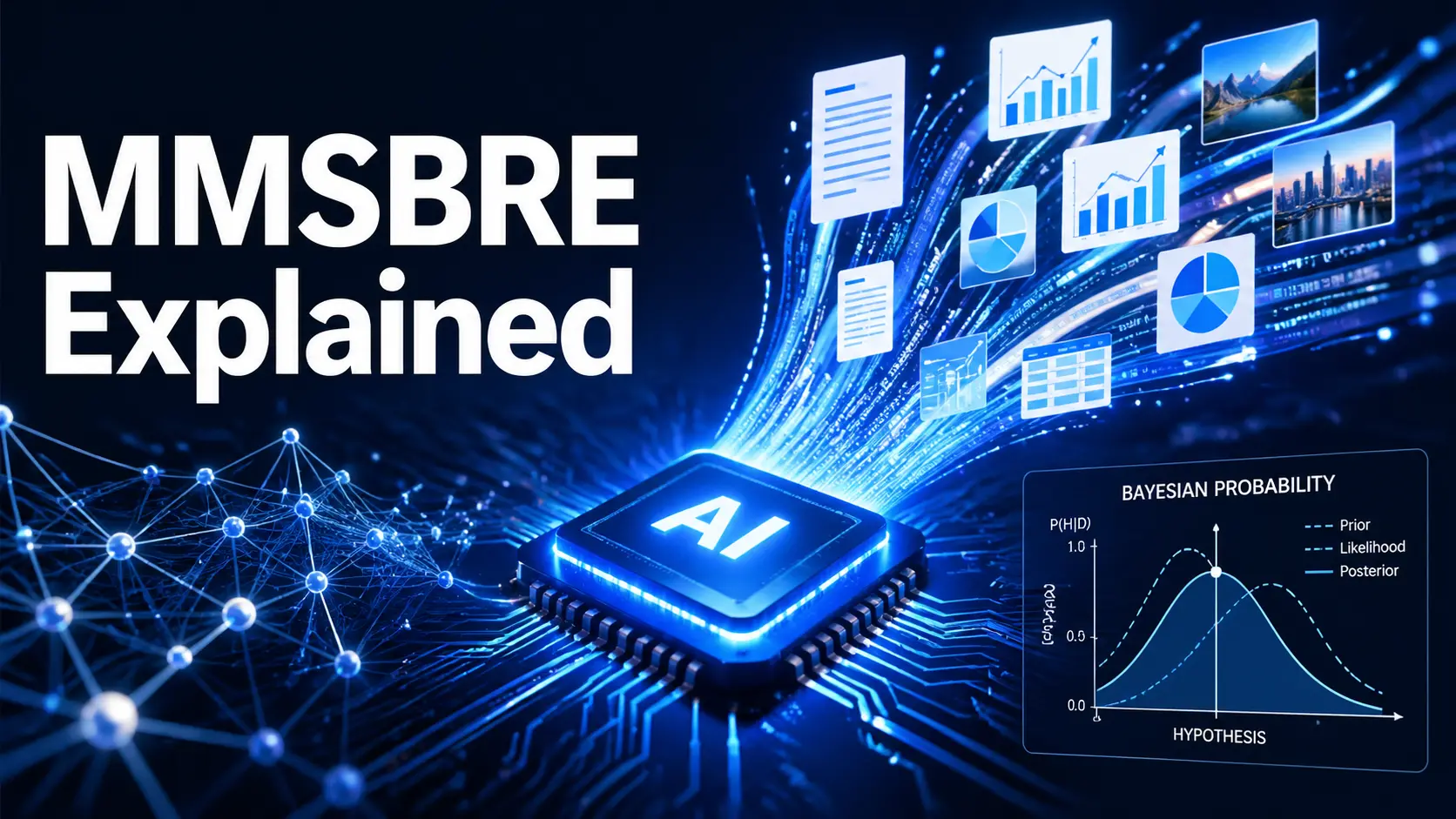
You’ve probably seen the term MMSBRE floating around in AI and data science conversations lately. And if you searched for it expecting a simple, jargon-free explanation — you’re in the right place. Here’s what I found after digging deep into this topic.
MMSBRE is one of the most quietly powerful concepts in modern predictive modeling, yet most explanations make it far more complicated than it needs to be. This article breaks it all down in plain language, covers what competitors missed, and gives you a real understanding of why MMSBRE actually matters in 2026.
What Exactly Is MMSBRE?
MMSBRE stands for Multi-Modal Sequential Bayesian Regression Estimator. That’s a mouthful, but each word actually tells you something useful about what it does.
“Multi-Modal” means the system works with different types of data at the same time — think text, images, numbers, and even audio all feeding into one model together. “Sequential” means it keeps learning as new data comes in, rather than stopping after the first training run. “Bayesian Regression” is a probability-based method that updates predictions using both old knowledge and new evidence. And “Estimator” simply means it’s built to calculate and predict outcomes.
Put it all together, and MMSBRE is an adaptive AI system that processes multiple data formats, learns continuously, and gives you increasingly accurate predictions over time. That combination is rare, and it’s exactly why organizations across healthcare, finance, and technology are paying attention to it right now.
Why MMSBRE Matters More Than Traditional AI Models
Most traditional machine learning models are trained once, then used as-is. They’re good at what they were built for — but once conditions change, they can’t adjust on their own. You’d have to retrain the entire model from scratch, which takes time, money, and expertise.
MMSBRE works differently. Because of its sequential learning design, the model updates itself automatically as new information arrives. This matters enormously in real-world applications where data is never static. Stock prices shift by the second. Patient health data changes daily. Consumer behavior evolves weekly. A model that can’t adapt to these changes becomes outdated fast.
Another major difference is uncertainty handling. Traditional regression models often give a single, fixed answer. MMSBRE’s Bayesian foundation means it acknowledges uncertainty in the data and gives a range of probable outcomes instead. That’s more honest, and frankly more useful when you’re making high-stakes decisions.
How MMSBRE Actually Works — Without the Technical Jargon
Here’s a simplified walkthrough of the MMSBRE process that actually makes sense.
The system first collects data from multiple sources — text documents, numerical records, images, sensor readings, whatever is relevant to the task. This raw data then gets cleaned and preprocessed. Missing values get filled, errors get removed, and different formats get converted into a consistent structure the model can read.
Once the data is ready, the Bayesian modeling phase begins. The system builds an initial prediction based on existing knowledge, much like an experienced analyst making an educated guess before all the facts are in. Then, as new data keeps coming in, the model updates that prediction step by step. Each update incorporates both the earlier knowledge and the latest information, producing a progressively refined result.
The final output is a prediction — or often a set of predictions with confidence levels attached. These outputs are what doctors, financial analysts, or business leaders actually use to make informed decisions. The whole process runs continuously rather than in isolated batches, which is where MMSBRE genuinely pulls ahead of older methods.
Real Industries Using MMSBRE Right Now
The reason MMSBRE is gaining traction isn’t theoretical — it’s solving real problems across multiple sectors.
In healthcare, hospitals deal with patient data in many formats at once: lab results, scan images, doctor notes, and wearable device readings. MMSBRE can combine all of these into one model to help predict patient deterioration before it becomes critical. Some facilities using similar Bayesian multi-modal approaches have reported up to 30% improvement in early diagnosis accuracy compared to single-data-stream models.
In finance, traders and analysts need predictions that update in real time. MMSBRE handles this naturally by ingesting stock prices, earnings reports, social media sentiment, and economic indicators simultaneously. The sequential update mechanism means the model adapts to market shocks within minutes instead of hours.
In marketing and e-commerce, understanding customer behavior requires combining browsing history, purchase records, and demographic data. MMSBRE helps businesses build a more complete picture of their customers, leading to sharper targeting and better return on ad spend.
Autonomous vehicle systems also rely on this kind of multi-modal, real-time learning. A self-driving car processes visual data, LiDAR readings, speed sensors, and GPS simultaneously — exactly the kind of workload MMSBRE-style architectures are designed for.
Common Mistakes People Make When Thinking About MMSBRE
One mistake that comes up often is assuming MMSBRE is just another name for deep learning. It’s not. Deep learning is a specific type of neural network approach. MMSBRE is a broader architectural concept that can incorporate deep learning components, but its foundation is Bayesian — which gives it the probabilistic, uncertainty-aware behavior that deep learning alone doesn’t inherently provide.
Another common misunderstanding is treating MMSBRE as a plug-and-play tool you can deploy overnight. The multi-modal data integration step requires careful preprocessing. If your input data from different sources isn’t aligned properly — same time stamps, compatible formats, cleaned for errors — the model’s output will be unreliable regardless of how advanced the algorithm is. Garbage in, garbage out still applies.
Some people also underestimate the computational cost. Running a sequential Bayesian model across multi-modal inputs in real time demands serious infrastructure. Smaller teams often need cloud-based solutions or optimized edge computing setups to make MMSBRE practical. Knowing this upfront saves a lot of frustration during implementation.
Best Practices for Getting Results from MMSBRE
If you’re working with MMSBRE or planning to implement a similar system, a few practical tips make a significant difference.
Start with data quality, not model complexity. A simpler MMSBRE setup with clean, well-structured data will outperform a sophisticated one built on noisy inputs. Audit your data sources thoroughly before anything else.
Define your update frequency carefully. Sequential learning sounds appealing, but updating predictions too frequently can cause the model to overfit to short-term noise. Finding the right update interval for your specific use case — whether that’s every hour, every day, or every transaction — is one of the most important tuning decisions you’ll make.
Monitor for bias regularly. Multi-modal systems can amplify existing biases in data because they combine multiple potentially biased sources. Setting up automated bias detection checks as part of your pipeline is non-negotiable if your predictions affect real people.
FAQs About MMSBRE
What does MMSBRE stand for?
MMSBRE stands for Multi-Modal Sequential Bayesian Regression Estimator. It’s an AI-driven predictive framework that combines multiple data types with continuous learning and probability-based modeling to generate accurate, adaptive predictions.
Is MMSBRE the same as regular machine learning?
No. Standard machine learning models are typically trained once on a fixed dataset. MMSBRE updates continuously as new data arrives and handles uncertainty more transparently through its Bayesian foundation, making it more adaptive than conventional ML approaches.
Which industries benefit most from MMSBRE?
Healthcare, finance, and autonomous systems see the biggest gains because these fields deal with fast-changing, multi-format data where real-time accuracy is critical. Marketing and e-commerce also benefit significantly from its customer behavior modeling capabilities.
How difficult is it to implement MMSBRE?
It’s not beginner-friendly. Proper implementation requires expertise in Bayesian statistics, data preprocessing, and multi-modal data alignment. Most successful deployments involve experienced data science teams and solid cloud or on-premise computing infrastructure.
Can small businesses use MMSBRE?
Yes, but with realistic expectations. Smaller organizations can leverage cloud-based AI platforms that incorporate Bayesian and multi-modal principles without building everything from scratch. The key is starting with a specific, well-defined prediction task rather than trying to do everything at once.
Does MMSBRE replace human analysts?
No — it enhances them. MMSBRE delivers faster and more data-rich insights, but human judgment remains essential for interpreting context, setting ethical boundaries, and making final decisions. Think of it as a highly capable analytical assistant, not a replacement.
What’s the biggest challenge with MMSBRE?
Data integration is consistently the hardest part. Combining text, images, and numerical data from different systems requires significant preprocessing work. Teams that underinvest in this stage often end up with models that look sophisticated but deliver unreliable outputs.
Final Thoughts
MMSBRE represents a meaningful step forward in how we build predictive systems. By combining multi-modal data processing, continuous sequential learning, and Bayesian probability modeling, it addresses limitations that have held back traditional AI approaches for years. It adapts to changing conditions, handles uncertainty honestly, and delivers more complete insights by looking at multiple data sources simultaneously.
If you’re in a data-intensive field — healthcare, finance, autonomous systems, or even advanced marketing — MMSBRE is worth understanding deeply, not just at the surface level. The organizations getting the most value from it right now are the ones who invested time in clean data infrastructure and realistic implementation goals before rushing into deployment.
The future of MMSBRE looks strong as edge computing, IoT, and real-time analytics continue to expand. What matters most is knowing how to apply it where it genuinely fits. When used right, MMSBRE doesn’t just improve predictions — it changes how decisions get made.